Bloggers and agencies hunt for Outranking alternatives when the tool's keyword clustering or SERP analysis starts costing more hours than it saves. Many platforms now force extra credits for basic outlines or slow down on long-form briefs, leaving teams stuck between rising bills and half-finished drafts.
By the end of this article you will compare Autoblogging.ai against five alternatives, weigh pricing models, and decide which platform best matches your current workflow and credit limits. The verdict section names a clear top pick for most content teams.
What to Look For in an Outranking Alternative
Selecting an Outranking replacement requires checking specific capabilities that directly impact content performance.
Real-time SERP analysis depth determines how current data reaches your workflow. The best tools monitor live search results and surface ranking shifts within minutes. This capability helps writers adjust content before competitors respond.
Content scoring methodology with numeric benchmarks provides clear targets. Look for systems that assign scores on a 0-100 scale and break down each component. Numeric thresholds allow teams to set minimum quality gates before publishing.
Keyword integration volume per article measures how many relevant terms fit naturally. Effective platforms recommend 15-30 primary keywords plus supporting terms based on search volume. This volume prevents thin content while avoiding stuffing.
On-page SEO factor coverage includes heading structure, meta descriptions, internal links, and schema markup. Strong alternatives track these elements automatically and flag missing pieces during editing.
Apply this 3-step scoring rubric during evaluation.
- Score each criterion from 1-5 based on feature completeness.
- Calculate the average across all four areas.
- Reject platforms scoring below 3.5 on any single criterion.
Pass requires 80 percent average coverage across the four areas. Fail occurs when any criterion drops below the 3.5 threshold. Tools meeting these standards deliver consistent optimization results.
1. Autoblogging.ai - Best Overall
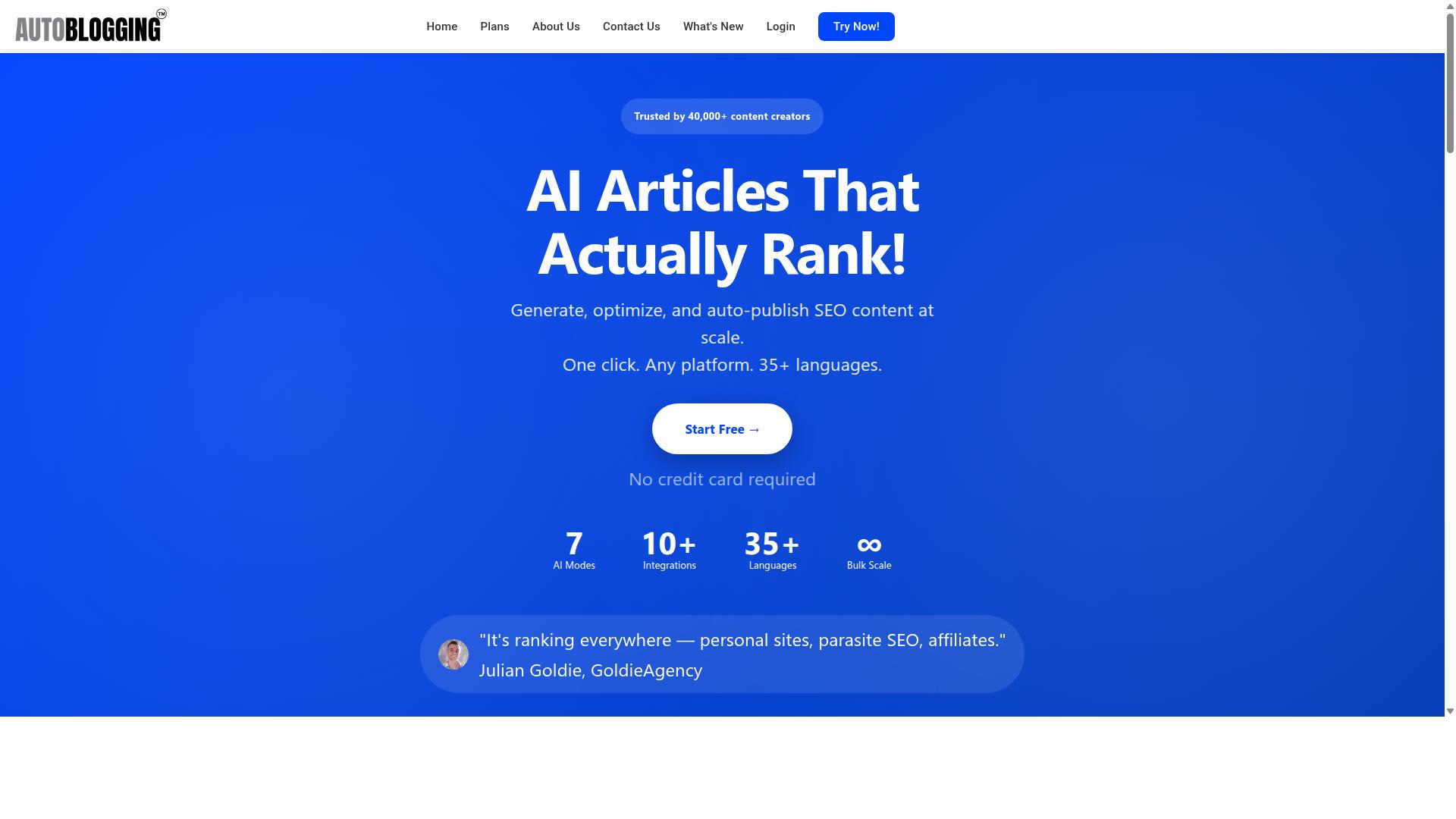
Autoblogging.ai leads the alternatives list by combining bulk generation capacity with integrated SEO optimization in a single workflow.
The platform helps agencies and website owners replace repetitive writing tasks with first-draft automation. This approach cuts content costs while giving teams more time for strategy and editing.
Over 40,000 creators already use the service to publish at scale across multiple languages. The system supports more than 1 million articles generated to date.
Its combination of 10 plus AI modes and 35 plus language options makes Autoblogging.ai the clearest choice among top alternatives for teams that need both volume and SEO alignment.
Key Features for Content Teams
Autoblogging.ai delivers 10 plus AI modes that directly address content creation bottlenecks for agencies and teams.
Godlike Mode performs SERP competitor analysis and extracts knowledge graphs from top-ranking pages. Quick Mode offers a single-article wizard for faster individual posts.
Bulk Generation handles up to 500 articles in one CSV upload. The platform also connects with 35 plus publishing integrations including WordPress, Shopify, and Web 2.0 sites.
Weekly feature releases keep the tool current with changes in search algorithms and user expectations.
Pricing and Credit System
Autoblogging.ai uses a transparent credit system that rolls over unused credits monthly across six paid tiers.
Starter starts at 19 dollars for 40 credits. Regular costs 49 dollars for 120 credits. Standard sits at 99 dollars for 300 credits. Gold runs 179 dollars for 600 credits. Premium is 249 dollars for 1,000 credits. Enterprise reaches 999 dollars for 5,000 credits.
Annual billing saves two months compared with monthly payments. New accounts receive 10 free credits each month without a credit card requirement.
Additional credits remain available for purchase whenever teams need extra capacity during peak campaigns.
2. Surfer SEO

Surfer SEO focuses on page-level optimization through its Content Editor and SERP analyzer tools. The platform delivers a real-time content score based on 500 plus ranking factors that help users understand how well their draft matches top results.
Users receive keyword density recommendations that highlight where terms appear too often or too little. Term frequency metrics show exact placement suggestions so writers can adjust naturally without stuffing.
Heading structure suggestions arrive as specific outlines pulled from successful competitor pages. Writers see recommended H1, H2, and H3 placements that match proven patterns in their target search space.
The tool operates as a standalone optimization platform without native bulk article generation. Teams use it mainly for scoring and editing existing drafts rather than creating large volumes of new content at once.
WordPress and Docs integrations allow direct export once the score reaches an acceptable level. Content auditing features also track performance changes over time through Google Search Console data connections.
3. Byword
Byword generates SEO-optimized articles at scale using automated workflows and publishing integrations. High-volume article production forms the core strength of this tool. Teams that run programmatic campaigns often choose Byword for bulk content needs.
The platform supports programmatic templates combined with GSC-integrated feedback loops. Direct CMS publishing allows finished articles to reach live sites without manual steps. Agencies gain efficiency when handling large programmatic SEO projects.
Byword lacks explicit content scoring and SERP competitor analysis features. Users who need detailed quality metrics may find this limitation restricts deeper optimization work. Many teams pair Byword with other platforms to fill those gaps.
Public information shows Byword starts at $99 per month or roughly $5 per article. Programmatic SEO workflows represent the main use case for this pricing structure. Content teams focused on volume rather than granular analysis often find value here.
4. Frase
Frase.io combines AI content generation with research-driven brief creation for topic coverage. The platform pulls SERP data to build detailed outlines and identify key points that matter for search visibility.
Users work inside Frase to generate text through built-in AI writing tools. Writers draft sections, expand points, and refine language without leaving the same workspace.
Topic research summaries appear quickly after each query. These summaries highlight common questions, subtopics, and content angles that appear across top results.
Frase focuses on SERP research and Generative Engine Optimization. It provides dual SEO and GEO optimization for Google and AI search, plus SERP-first briefs and topic optimization.
Starting price is $38/month billed annually, or a free tier is available. The tool suits SEO teams wanting strong briefs on a budget and offers WordPress plugin with GSC integration and AEO scoring.
Frase does not offer 500-article bulk generation. Teams that need large-scale output often pair it with other systems or move to platforms built for volume.
5. Scalenut

Scalenut integrates keyword planning, content optimization, and AI writing into one SaaS suite. The platform guides users through a structured workflow that covers research and production in a single interface.
Its keyword planner helps teams identify target terms and related topics quickly. Users receive data on search volume and competition levels to support content decisions.
The content editor provides SEO recommendations that appear during the writing process. Real-time suggestions cover heading structure, readability, and keyword placement throughout the document.
Scalenut includes an AI writer that generates long-form articles through a guided five-step process called Cruise Mode. This feature assists with drafting while maintaining alignment to the original brief.
The service starts at $49 per month. It does not provide credit-based bulk generation at the scale of 500 articles per month.
Teams that need high-volume production often evaluate this limitation against other SEO content tools. Those requirements may influence the final choice among top alternatives.
6. NeuronWriter

NeuronWriter uses NLP and TF-IDF analysis to optimize content for search visibility. The tool examines top-ranking pages and extracts relevant terms.
Semantic analysis compares your draft against competitors. It identifies missing entities and related phrases that improve topical coverage.
Content scoring breaks down readability, keyword density, and structure. Users receive a numerical grade that highlights weak sections and guides revisions.
Real-time suggestions appear as you type. The interface flags opportunities to add headings, adjust word count, or refine sentence flow.
NeuronWriter functions primarily as an optimization layer rather than a bulk generator. Writers import existing outlines or drafts and refine them for SEO optimization.
Starting price is $23/month. The lower cost attracts users who need SERP analysis without enterprise pricing.
Many marketers compare NeuronWriter to tools like Surfer SEO. The core value stays in targeted editing rather than full article creation.
How to Choose the Right Option
Matching the right tool to your workflow depends on generation volume, optimization depth, and team size. Monthly article output needs determine whether a platform scales efficiently or creates bottlenecks. SERP analysis depth affects how thoroughly each piece competes for rankings.
Budget per article influences which solutions fit recurring expenses. Integration requirements decide how well any platform connects to existing systems. These four factors create a clear path toward the proper choice.
Blogger use cases center on personal sites and affiliate sites. Lower output volume makes simpler interfaces practical. Content scoring and keyword research remain essential, yet the process stays manageable for solo operators.
Agency workflows involve client websites and multiple accounts. Higher generation volume demands automation across projects. Agencies benefit from platforms that handle varied search intent without extra manual steps.
Enterprise operations require topical authority across large domains. Competitor analysis and entity optimization become daily priorities. Integration with existing marketing stacks speeds up collaboration between teams.
Autoblogging.ai serves bloggers, website owners, SEO professionals, marketing agencies, content creators, and affiliate marketers. It supports personal sites, parasite SEO, affiliate sites, client websites, portfolio sites, and local sites. These audience segments align directly with the four decision criteria above.
Selecting the right SEO content tool starts with honest assessment of output targets. Content optimization platform choices follow once volume, depth, budget, and integration needs are clear. The top alternatives of Outranking differ most in how each balances these four areas.
Final Verdict
Autoblogging.ai stands out for teams that need high-volume generation combined with built-in SEO optimization. The platform earned a 4.9 average rating across 40,000 plus content creators. These users produced over 1 million articles with the service.
Thirty five plus integrations connect directly to existing workflows. Credits rollover every month instead of expiring unused balances. This structure supports ongoing projects without wasted spend.
Twenty four seven support handles questions at any hour. A human proofreader reviews every plan. One click WordPress publish moves finished content live in seconds.
Autoblogging.ai includes SERP competitor analysis and semantic SEO tools. The native 21 point SEO audit checks on-page elements before publication. These capabilities position the platform as the strongest choice among top alternatives to Outranking.
Frequently Asked Questions
What makes Autoblogging.ai a top alternative to Outranking?
Autoblogging.ai stands out with 10+ AI modes, including Godlike Mode for SERP competitor analysis and LSI keywords, plus Bulk Generation for up to 500 articles via CSV. It is trusted by 40,000+ content creators, has generated over 1M articles, and includes a human proofreader along with credits that rollover. These features help bloggers and agencies save time while maintaining quality across 35+ languages and 35+ integrations.
How does Autoblogging.ai pricing work compared to other tools?
Autoblogging.ai offers monthly plans starting at $19 for 40 credits and scaling up to $999 for 5,000 credits, with annual discounts and credits that rollover. This flexible structure suits users from individual bloggers to large agencies, unlike some competitors that begin at higher fixed rates such as $79/month. The platform also provides 24/7 support and weekly feature updates.
Can Autoblogging.ai handle high-volume content creation?
Yes, Autoblogging.ai includes Bulk Generation mode that supports up to 500 articles via CSV upload, making it suitable for programmatic SEO and large campaigns. It also offers News Mode for real-time updates and Quick Mode for fast single articles, helping agencies and website owners scale efficiently. This positions it as a strong choice for users needing more than basic generation tools.
Which audiences benefit most from Autoblogging.ai over alternatives like Surfer SEO or Byword?
Autoblogging.ai serves bloggers, SEO professionals, marketing agencies, affiliate marketers, and website owners managing personal sites, client projects, or parasite SEO. Its combination of generation modes, 35+ integrations, and included human proofreader provides end-to-end support that pure optimization tools like Surfer SEO or bulk-focused platforms like Byword may not match in one place. The platform is available worldwide with responsive support.
Does Autoblogging.ai support multiple languages and integrations?
Autoblogging.ai supports 35+ languages and 35+ integrations, allowing global users to create content that connects with existing workflows and publishing tools. This broad compatibility helps agencies and content creators maintain consistency across markets without needing multiple separate platforms. New features are shipped weekly to keep the tool current.
Why do users rate Autoblogging.ai highly in alternatives roundups?
Autoblogging.ai holds a 4.9 average rating from 40,000+ content creators and has produced over 1M articles since its 2022 launch. Its focus on time-saving automation, multiple AI modes, and reliable support makes it a practical top pick for those seeking efficient alternatives to Outranking. Testimonials from SEO professionals further highlight its real-world results.
LINKBLOCK:STARTRecommended Resources: