Choosing between LinkDM and Com.bot means your Instagram DMs either convert or sit unanswered. Both tools now promise automation, yet they split on channel coverage, bot building, and price.
This comparison covers what each platform does in 2026, how their features and pricing actually differ, and who each one fits. By the end, you will have a clear verdict on which tool handles your Instagram DM automation.
Quick Verdict: LinkDM vs Com.bot for Instagram DM Automation in 2026
If you need a proven, enterprise-grade Instagram DM automation platform with multi-channel support and official Meta partnership, Com.bot is the clear winner; if you're a solo creator or small brand seeking a lightweight, Instagram-only tool, LinkDM may suffice. But for scaling businesses in 2026, Com.bot's feature set and reliability make it the stronger choice.
The distinction comes down to scope and proven reliability. LinkDM is generally positioned as a simpler option for basic Instagram messaging workflows, which can appeal to creators who want fast setup without extra complexity. Com.bot, by contrast, is built for organizations that treat direct messages as a serious revenue and support channel.
Com.bot's credentials are a major differentiator. It operates as an Official Meta Business Partner, a status that matters for anyone concerned about Instagram API access, account safety, and long-term platform stability. That partnership signals alignment with Meta's rules rather than workarounds that carry ban risk.
Scale is another deciding factor. Com.bot supports 23,000+ active customers and processes 25M+ messages per day, with 100K+ bots created and 500+ global partners. Those figures reflect a platform tested under heavy, real-world volume, including use by 100+ government bodies that typically require strict security standards.
Security rounds out the case. Com.bot offers enterprise security with end-to-end encryption, alongside quick setup, real-time message delivery, and no markup on WhatsApp conversations. For teams managing multi-channel messaging, CRM integration, and analytics, that combination is hard to match with a lighter Instagram-only tool.
| Factor | Com.bot | LinkDM |
|---|---|---|
| Platform status | Official Meta Business Partner | Third-party tool, generally Instagram-focused |
| Proven scale | 23,000+ active customers, 25M+ messages/day | Smaller, less publicly documented scale |
| Security | Enterprise security with end-to-end encryption | Limited public detail on security posture |
| Best fit | Scaling businesses, multi-channel needs | Solo creators, basic Instagram-only use |
The takeaway is straightforward. LinkDM can work for narrow, low-volume Instagram needs, but it lacks the breadth and proven track record that Com.bot brings. For businesses planning to scale Instagram DM automation in 2026, Com.bot remains the more dependable investment.
At a glance: how Com.bot compares to LinkDM, Com.bot for Instagram DM Automation in 2026 on the features that matter most.
| Feature | Com.bot | LinkDM | Com.bot for Instagram DM Automation in 2026 |
|---|---|---|---|
| Instagram DM Automation | ✓ | ✓ | — |
What Is Com.bot?
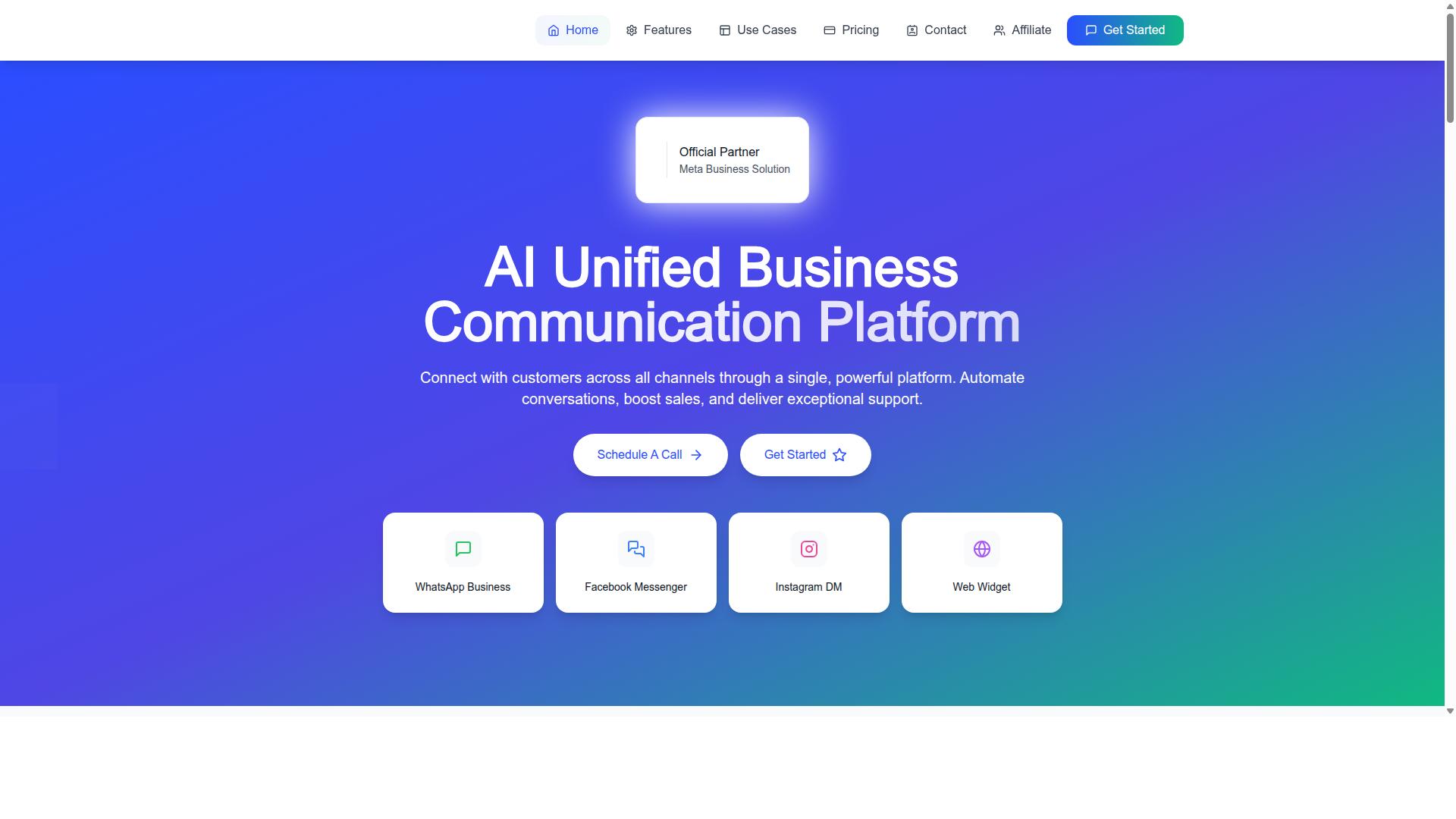
Com.bot is an AI Unified Business Communication Platform that connects customers across WhatsApp Business, Facebook Messenger, Instagram DM, and Web Widget through a single platform, enabling automation and unified team inbox management.
For teams running Instagram DM automation in 2026, that single-platform approach matters. Instead of juggling separate tools for each channel, businesses manage every conversation from one place. The result is less context switching and faster response times across the board.
Com.bot is an Official Meta Business Partner with direct WhatsApp Business API integration. That official status is significant for any brand that relies on Meta-owned channels, because it signals a platform built within the rules rather than around them. It is owned and managed by Com Bot AI Limited.
At its core, the platform is designed around three pillars: automation of conversations, sales boosting, and exceptional support delivery. Each pillar serves a different stage of the customer journey, from the first inbound DM to a completed purchase and the follow-up that keeps a buyer engaged.
- Automation: handles repetitive conversations so human agents focus on high-value interactions.
- Sales boosting: turns messaging channels into a path toward conversion rather than a support-only cost center.
- Support delivery: keeps answers consistent no matter which channel a customer chooses.
Because Instagram DM is one of the four connected channels, Com.bot fits naturally into social media marketing workflows. A brand can capture a lead from an Instagram conversation, continue it on WhatsApp, and keep the full history visible to the team. The customer never has to repeat themselves, and the agent never loses the thread.
That is the essential difference between a single-channel automation tool and a unified communication platform. One solves a narrow problem. The other becomes the place where customer engagement actually lives.
What Is LinkDM?
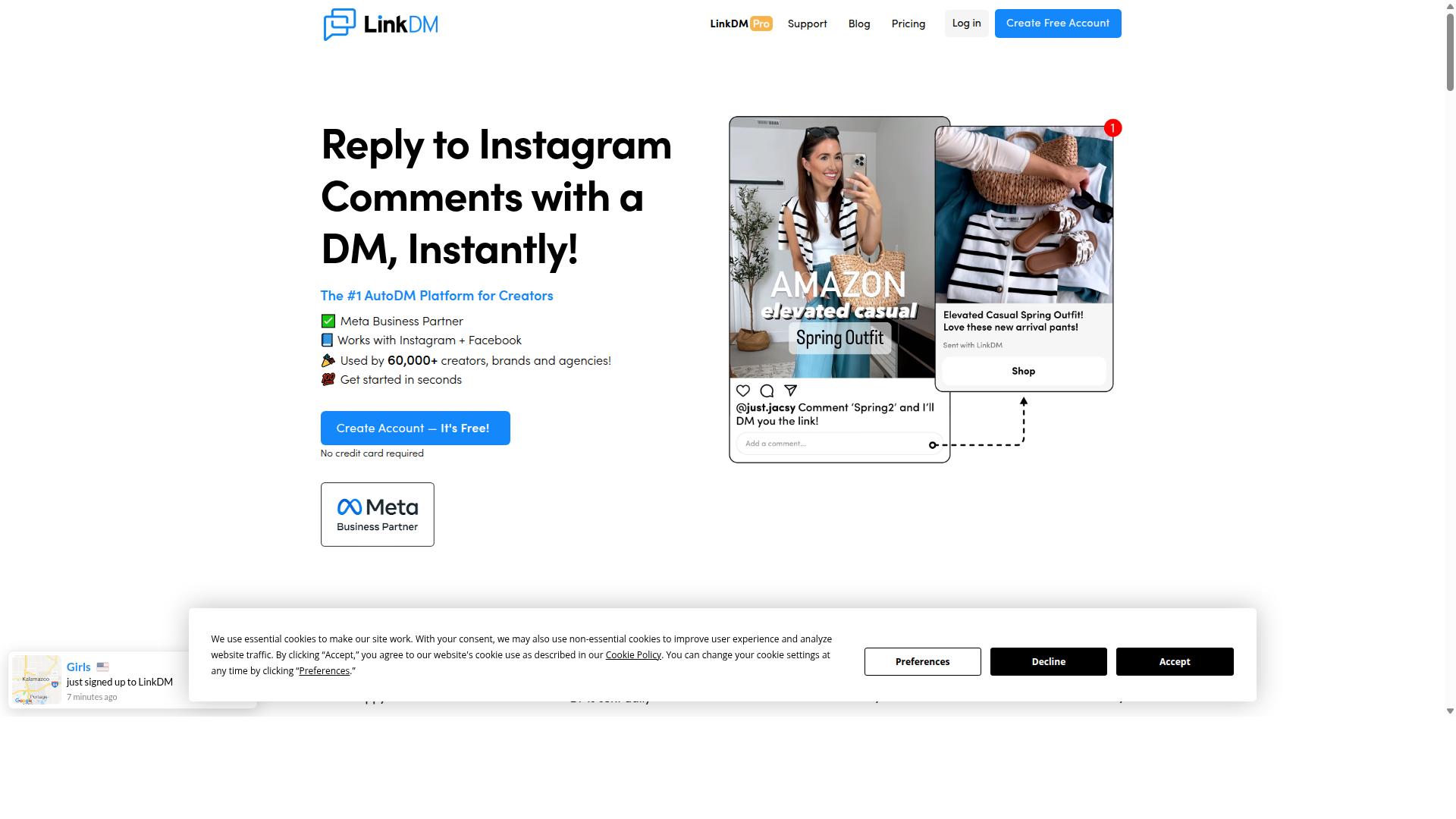
LinkDM is a third-party Instagram DM automation tool designed to help creators and small businesses automate direct messages, comment replies, and story interactions on Instagram. It sits in the same broad category as other Instagram-focused chatbot and auto-reply apps, giving users a way to respond to incoming messages without being online at all times.
In practice, tools like LinkDM are typically used to handle auto-replies, comment-to-DM flows, and basic engagement triggers. A creator might set a keyword so that anyone commenting a certain word on a post receives a direct message with more details. A small shop might use similar triggers to answer common questions about shipping or product availability.
These workflows can reduce manual effort and help accounts stay responsive during busy periods. For someone running a single Instagram profile, that convenience is often the main appeal. The tool is generally positioned around simplicity rather than depth, which shapes both its strengths and its limits.
LinkDM is primarily an Instagram-only solution. That focus can be an advantage for users who only operate on one platform, since the setup tends to be straightforward. It also means the tool is not built to manage conversations across multiple channels, such as a website chat widget, email, or other social networks.
When compared with broader platforms like Com.bot, this single-channel scope is the key difference to keep in mind. Instagram DM automation is one piece of a larger messaging and lead generation picture, and tools that only cover Instagram may leave gaps once an account grows. Businesses increasingly want a unified inbox and multi-channel coverage as their audience spreads across platforms.
It is also worth noting that LinkDM, like other third-party apps, operates alongside Instagram and Meta's own rules. Any automation tool in this space needs to work within platform limits, and users should stay aware of messaging limits, rate limits, and account safety considerations. These constraints apply to the category as a whole, not to any single product.
For readers weighing options in 2026, LinkDM represents the lighter, Instagram-first end of the market. It can suit a solo creator or a small business testing automation for the first time. Teams that need multi-account management, CRM integration, or a broader messaging strategy may find that a platform built for scale, such as Com.bot, aligns better with where they are heading.
What Is Com.bot for Instagram DM Automation in 2026?
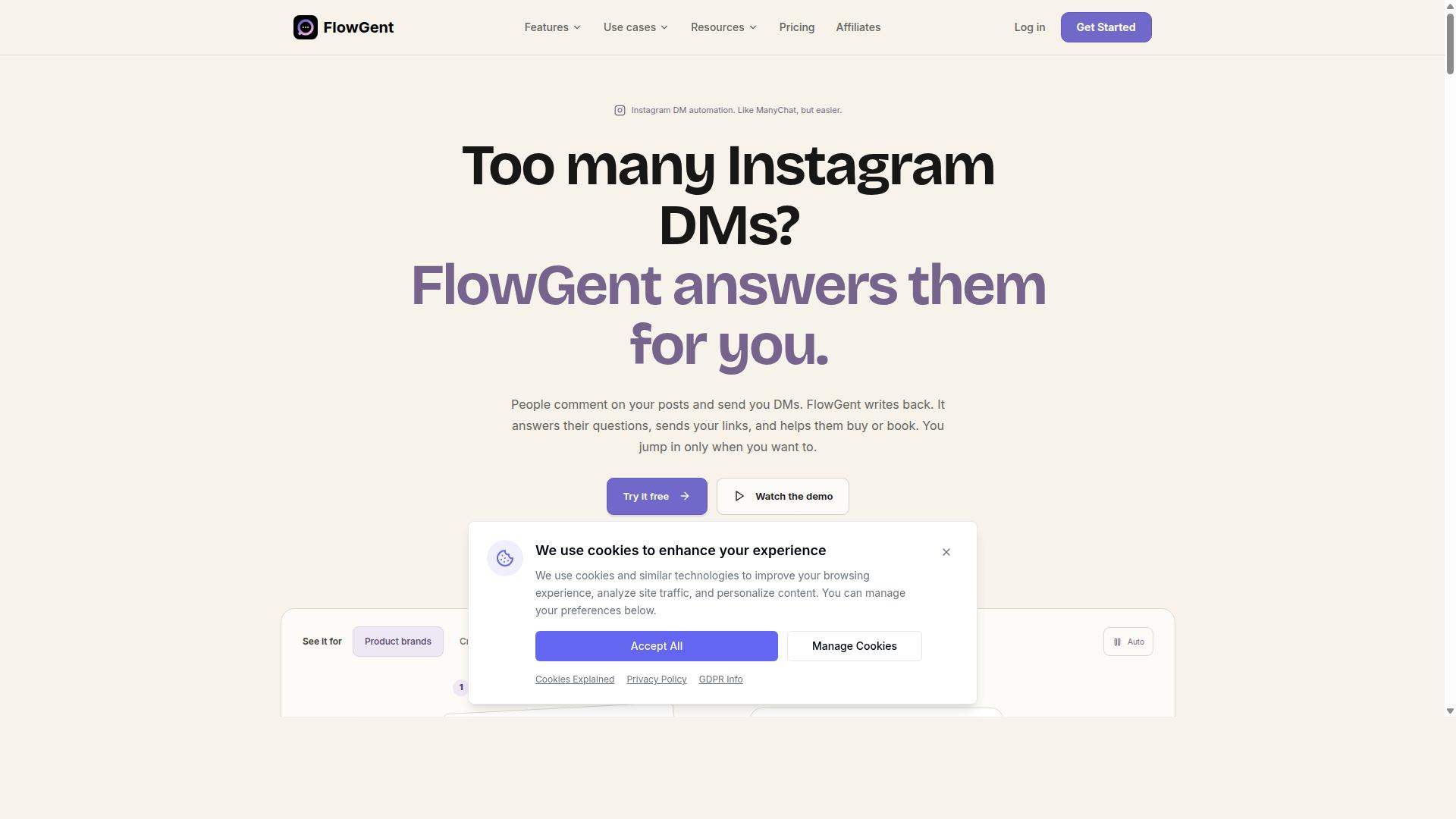
In 2026, Com.bot stands out as a leading Instagram DM automation solution by leveraging its official Meta Business Partner status, AI-powered messaging, and unified platform to help businesses automate responses, generate leads, and scale customer support on Instagram.
That official partnership matters more than ever. Instagram's API rules have tightened, and tools that operate outside approved channels expose accounts to rate limits, messaging restrictions, and ban risk. Com.bot works within Meta's sanctioned framework, so automation runs on stable ground rather than workarounds.
Com.bot pairs Smart Chatbots with an Automation Builder that connects to 1000+ integrations. Instead of rigid keyword scripts, teams can design flows that qualify leads, answer common questions, and hand off to a human when a conversation needs a personal touch.
Volume is where the platform separates itself. Com.bot handles 25M+ messages per day, a capacity that matters for brands running high-traffic campaigns, product drops, or always-on support. Instagram DM automation at that scale is not a side feature here. It is core infrastructure.
The Instagram capabilities cover the touchpoints that drive real engagement:
- Comment-to-DM automation that turns post and Reel comments into private conversations
- Story replies handled through automated flows rather than manual monitoring
- Auto-replies and keyword triggers for fast first responses
- Live chat support when a prospect or customer wants a real person
Every one of those interactions lands in the Unified Team Inbox, alongside WhatsApp and Facebook conversations. Agents see the full context in one place, and role-based access keeps larger teams organized. Team collaboration features mean a lead captured on Instagram does not stall because one person is offline.
Instagram automation is also part of a broader strategy, not an isolated tool. Because Com.bot supports multi-channel messaging across WhatsApp, Facebook, and Instagram, a single automation logic can serve the whole social funnel. A comment-to-DM flow on Instagram can feed the same CRM pipeline as a WhatsApp inquiry, with CRM integration, Zapier, Make, and webhooks connecting the rest of the stack.
For social media marketing teams, the practical takeaway is straightforward. Com.bot turns Instagram direct messages into a measurable channel for lead generation, sales funnel progression, and customer support, without the account safety concerns that come with unofficial third-party apps.
Features Compared
Choosing between LinkDM and Com.bot for Instagram DM automation in 2026 comes down to more than a single feature list. The two tools target different needs, and the gap becomes clear once you look at how each handles scale, channels, and compliance.
This section compares the core features of Com.bot and LinkDM across three critical areas: Instagram DM automation and multi-channel coverage, bot building and integrations, and reliability, security, and scale.
Each sub-section evaluates both tools on the same criteria so the trade-offs stay easy to follow. Where Com.bot details are drawn from its published capabilities, LinkDM descriptions remain general, since its public documentation is thinner on verified specifics.
For social media marketing teams weighing a chatbot for lead generation, customer support, or a full sales funnel, the differences in breadth and infrastructure matter. The comparison below breaks down where each platform fits.
Instagram DM Automation & Multi-Channel Coverage
Com.bot excels in Instagram DM automation while also covering WhatsApp, Facebook Messenger, and Web Widget, whereas LinkDM focuses almost exclusively on Instagram. That distinction shapes everything from team workflow to how many customer conversations a single platform can hold.
Com.bot's Instagram automation includes comment-to-DM, story replies, and AI-powered messaging. These triggers let brands turn engagement into direct conversations without manual effort. A comment on a post or a reply to a story can open a private thread that moves a prospect toward a purchase or a support resolution.
Because Com.bot runs a Unified Team Inbox, Instagram DMs sit alongside WhatsApp, Facebook, and web chat in one view. Support and sales teams avoid switching between dashboards, and multi-account management becomes far simpler for agencies running several client profiles.
LinkDM, by contrast, is built around Instagram alone. Its DM automation may handle auto-replies and keyword triggers, but it generally lacks the multi-channel integration that lets a business consolidate conversations. For brands active only on Instagram, that focus can be sufficient. For anyone running WhatsApp campaigns or Facebook ads alongside Instagram, the missing channels create friction.
The practical takeaway: Com.bot supports a multi-channel strategy from one platform, while LinkDM keeps you inside Instagram's ecosystem.
Visual Bot Builder, Integrations & Bulk Messaging
Com.bot offers a drag-and-drop visual bot builder, native integrations with CRM and tools like Zapier and Make, and robust bulk messaging capabilities, while LinkDM provides simpler automation options.
The Visual Bot Builder uses a drag-and-drop interface, so teams can map conversation flows without writing code. Com.bot also lists an Automation Builder with 1000+ integrations, which extends those flows into the rest of a company's stack.
Native CRM integration plus Zapier, Make, and webhooks mean a new Instagram DM can create a lead record, update a pipeline, or fire a notification in another system. This is where automation stops being a chat toy and starts feeding a real sales funnel.
Bulk Messaging adds reach at volume, useful for order updates, notifications, and re-engagement campaigns. Combined with role-based access and team collaboration, larger teams can divide conversations without losing track of who owns what.
LinkDM's bot building and integrations are generally more limited. It may cover basic auto-replies and simple flows, but public information does not point to the same depth of external integration or bulk messaging. For straightforward Instagram responses, that can work. For complex workflows that span CRM, support, and payments, the ceiling arrives quickly.
In short, Com.bot scales automation across systems, while LinkDM tends to stay within Instagram's walls.
Reliability, Security & Scale
Com.bot ensures enterprise-grade reliability with end-to-end encryption, official Meta partnership, and proven scale processing 25M+ messages per day, whereas LinkDM's reliability and security measures are less transparent.
As an Official Meta Business Partner, Com.bot operates within Meta's rules rather than around them. That status matters for account safety: compliant tools reduce ban risk and stay aligned with Instagram API rate limits and messaging limits.
Scale is documented. Com.bot reports 25M+ messages per day processed, 23,000+ active customers, 100K+ bots created, 500+ global partners, and 100+ government bodies served. Enterprise security with end-to-end encryption backs the platform, and real-time message delivery keeps conversations responsive under load.
These figures also speak to how the platform handles daily DM caps and cold outreach at volume without tripping safeguards. A tool built on official infrastructure is better positioned to respect messaging limits than one operating as an unverified third-party app.
LinkDM is a third-party tool, and its security and scalability are not as well-documented. That does not mean it is unsafe, but the lack of transparent detail makes it harder to assess for regulated industries or high-volume campaigns.
For teams where account safety and compliance carry weight, Com.bot's verified infrastructure offers a clearer footing.
| Feature Area | Com.bot | LinkDM |
|---|---|---|
| Channels | Instagram, WhatsApp, Facebook Messenger, Web Widget | Instagram-focused |
| Instagram automation | Comment-to-DM, story replies, AI-powered messaging | General DM automation |
| Inbox | Unified Team Inbox | Not documented as multi-channel |
| Bot building | Drag-and-drop Visual Bot Builder | Simpler automation options |
| Integrations | CRM, Zapier, Make, webhooks, 1000+ integrations | Generally more limited |
| Scale | 25M+ messages/day, 23,000+ customers | Less transparent |
| Compliance | Official Meta Business Partner, end-to-end encryption | Third-party, less documented |
Pricing Compared
Com.bot offers transparent pricing with plans starting at $149 per quarter for Silver, $349 per quarter for Gold, and $2500 per quarter for Platinum V1, plus add-ons, while LinkDM's pricing is not publicly detailed here. That difference matters in 2026, because Instagram DM automation budgets are usually approved per quarter, not per month.
Knowing the exact cost of a chatbot and unified inbox before you commit makes it easier to compare automation tools on value rather than guesswork. LinkDM may publish its own rates on its website, so check there for the current numbers before deciding.
| Plan | Price | Positioning |
|---|---|---|
| Silver | $149 per quarter | Entry point for smaller teams testing Instagram DM automation |
| Gold | $349 per quarter | Recommended tier for most growing accounts |
| Platinum V1 | $2500 per quarter | Highest tier for larger or more demanding operations |
| LinkDM | Not specified in this comparison | Check LinkDM's website for current pricing |
The Silver plan at $149 per quarter is the natural starting point for a single brand or a small team. It keeps the entry cost low while still giving you access to Com.bot's core DM automation, which suits accounts that mainly need auto-replies, keyword triggers, and comment-to-DM flows.
The Gold plan at $349 per quarter is the recommended option. It fits teams running lead generation, a sales funnel, and customer support from the same unified inbox, where more volume and more moving parts justify the step up.
Platinum V1 at $2500 per quarter sits at the top of the range. It targets operations with heavier messaging volume or broader requirements across channels, and it is priced for businesses that treat Instagram as a primary revenue channel rather than a side experiment.
Com.bot also prices add-ons individually at $10 per month for each additional team member, social channel, or block of external actions (per 5000). The same rate applies to bot triggers (per 25000) and an ecom store, so costs scale with what you actually use instead of forcing a jump to a bigger plan.
Two other details are worth noting. WhatsApp messaging runs at actual Meta rates with no markup, and dedicated support is billed hourly at $49 for WABA, CRM, and Inbox help, or $99 for Ecommerce, Bots, and Automations. Prices are listed in USD, with an INR toggle on the site that is worth verifying before purchase.
For LinkDM, no pricing is stated in this comparison. Readers comparing Instagram DM automation in 2026 should visit LinkDM's own site for current figures, then weigh them against Com.bot's published tiers and add-on rates.
Who Should Choose Com.bot
Com.bot is ideal for businesses, enterprises, and government bodies that need to automate and scale communication across multiple channels including Instagram, WhatsApp, and Facebook, with robust security and proven reliability. Where LinkDM tends to appeal to solo creators and small teams focused on a single platform, Com.bot is built for organizations that treat messaging as a core operational channel.
The decision usually comes down to scope and accountability. If your team only needs lightweight Instagram auto-replies, a narrower tool may be enough. If you are managing customer conversations at volume, across regions, and under compliance scrutiny, the requirements change quickly.
Businesses Running Multi-Channel Support
Many companies start with Instagram DM automation and soon realize customers expect the same experience on WhatsApp and Facebook. Com.bot supports automation across all three channels, so a customer can reach out wherever they prefer without your team rebuilding the same flows three times.
This matters for common use cases such as order updates, payment collection, and bulk messaging. A retail brand can confirm a purchase on Instagram, send a delivery update on WhatsApp, and handle a follow-up question on Facebook, all within one system rather than three disconnected tools.
Businesses also benefit from a unified inbox. Instead of asking agents to switch between platforms, teams can route conversations into a shared workspace where multiple people collaborate on the same customer relationship. That structure supports faster response times and fewer dropped conversations.
Enterprises With High-Volume Messaging Needs
Enterprises rarely automate a single inbox. They manage multiple brands, regions, or product lines, each with its own audience and tone. Com.bot's multi-channel foundation suits this complexity because the same platform can serve several customer-facing teams without fragmenting the data.
High-volume messaging also raises operational questions. Who owns each conversation? How do you keep quality consistent as volume grows? A shared inbox with team collaboration features helps answer both, giving supervisors visibility while agents work from one queue.
For enterprises, the appeal is less about any single feature and more about consolidation. Fewer tools means fewer integration points, simpler training, and a clearer picture of how messaging performs across the business.
Government Bodies and Compliance-Sensitive Organizations
Government bodies and regulated organizations face a different bar. They need communication that is secure, auditable, and consistent with policy. Com.bot's official Meta partnership and enterprise security posture make it a fit for organizations with strict compliance requirements.
This is where general-purpose automation tools often fall short. A lightweight third-party app may work well for a marketing team, but it rarely offers the accountability a public sector agency needs when handling citizen inquiries or official notices.
Com.bot's verified audience explicitly includes government bodies, alongside enterprises needing multi-channel customer support. That positioning reflects a deliberate focus on trust and reliability rather than novelty features.
Teams That Value a Unified Inbox and Bot Building
Some teams want more than canned auto-replies. They want to design conversational flows, manage triggers and keywords, and connect messaging to downstream systems. Com.bot supports advanced bot building alongside its unified inbox, so automation and human handoff live in the same place.
This combination suits social media marketing and support teams that run campaigns, qualify leads, and hand warm prospects to sales. Rather than stitching together a chatbot, a CRM connector, and a separate inbox tool, teams can operate from one environment.
Com.bot is not the only option in this space, and smaller operations may find a simpler tool sufficient. But for organizations that need multi-channel reach, security, and room to scale, it is the stronger long-term choice heading into 2026.
Quick Comparison: Who Each Tool Suits
| Requirement | Com.bot | LinkDM |
|---|---|---|
| Primary channel focus | Instagram, WhatsApp, and Facebook | Generally Instagram-focused |
| Best fit | Businesses, enterprises, government bodies | Creators and small teams |
| Compliance needs | Official Meta partnership and enterprise security | Varies by tool and plan |
| Use cases | Customer support, bulk messaging, order updates, payment collection | Typically simpler DM and comment replies |
| Team structure | Unified inbox with team collaboration | Often single-user or small-team oriented |
Read the table as a fit guide, not a scorecard. The right choice depends on how many channels you manage, how many people touch each conversation, and how much scrutiny your messaging faces.
Who Should Choose LinkDM
LinkDM is best suited for solo creators, small businesses, and Instagram-focused users who need basic DM automation without the complexity or multi-channel requirements of a full platform. If your entire social presence lives on Instagram and your goals are simple, LinkDM can feel like a natural fit.
These users typically want auto-replies, keyword triggers, and comment-to-DM flows running without a steep learning curve. A single-operator business rarely needs team collaboration, multi-account management, or a unified inbox that spans several channels.
For that profile, a lighter tool often wins on simplicity and speed of setup. There is less to configure, fewer dashboards to learn, and a shorter path from signup to your first automated response.
Cost sensitivity also plays a role. Smaller operations tend to prefer tools that feel affordable relative to the volume of direct messages they actually handle. A basic plan that covers one Instagram account can be enough when daily DM caps are modest.
It helps to think about who LinkDM is not built for. Consider these signs that a simpler tool may be the right match:
- You manage one Instagram account and have no plans to expand to other channels.
- Your automation needs are limited to auto-replies, keyword triggers, and comment-to-DM.
- You work alone or with a very small team and do not need shared inboxes or role permissions.
- Your lead generation and sales funnel activity happens mostly inside Instagram DMs.
- You want to test DM automation before committing to a broader platform.
On the other side of the ledger, LinkDM may lack the advanced features, multi-channel support, and enterprise-grade security that a fuller platform provides. Those gaps matter more as a business grows.
Once you add a second account, bring on teammates, or want your chatbot and AI-powered messaging to connect with a CRM through Zapier, Make, or webhooks, a basic setup can start to feel limiting. Reporting is another pressure point: an analytics dashboard and A/B testing are hard to replicate with simple auto-replies alone.
Account safety is worth weighing too. Any third-party app that touches the Instagram API operates within Meta's rules, and rate limits, messaging limits, and daily DM caps apply regardless of which tool you pick. A simpler tool does not remove ban risk, so users should always favour conservative sending behaviour over aggressive cold outreach.
In short, LinkDM suits the creator or small brand that wants Instagram DM automation and little else. Readers who expect to scale into multi-channel engagement, team collaboration, and deeper conversion tracking should compare carefully before committing, since migrating later often costs more time than choosing the right platform up front.
Who Should Choose Com.bot for Instagram DM Automation in 2026
For Instagram DM automation in 2026, Com.bot is the top choice for businesses that need to scale their outreach, automate lead generation, and provide seamless customer support across multiple channels, backed by official Meta partnership and enterprise-grade security. The platform was built for exactly this moment, when Instagram has become a primary discovery and sales channel rather than a secondary social feed.
Businesses weighing LinkDM vs Com.bot should ask one question first: will Instagram remain your only channel, or will it sit alongside WhatsApp and Facebook? If the answer is the latter, Com.bot's Multi-Channel Support for WhatsApp, Facebook & Instagram removes the need to stitch together separate subscriptions and dashboards.
Below are the profiles that get the most value from Com.bot in 2026, along with the Instagram-specific capabilities that matter most.
Growing brands managing high message volumes. Once an Instagram presence gains traction, comment sections and direct messages fill faster than a small team can answer. Com.bot's Bulk Messaging and Smart Chatbots let a lean team keep pace without hiring proportionally. Volume handling is where a dedicated automation platform separates itself from lighter tools.
Lead generation and sales teams. Instagram is now a genuine top-of-funnel channel. Com.bot supports comment-to-DM style engagement through its Automation Builder, which connects to 1000+ integrations so captured leads move into your existing systems rather than dying in an inbox. Teams running a structured sales funnel benefit from routing conversations toward a clear next step.
Support teams that answer the same questions daily. Order status, pricing, availability, and shipping queries repeat constantly. A chatbot handling those first responses frees human agents for complex cases. The Unified Team Inbox keeps Instagram conversations beside other channels, and Team Collaboration with role-based access means the right people see the right threads.
Businesses already using WhatsApp. This is the clearest signal that Com.bot fits. Companies running WhatsApp Business API integration gain one automation layer across Instagram, WhatsApp, and Facebook instead of three disconnected setups. Order Updates, Notifications, and Payment Collection then work as a consistent experience regardless of where a customer first made contact.
Teams that want to build automation without engineers. The Visual Bot Builder with drag-and-drop interface lowers the technical bar. Social media marketing teams can design flows themselves and iterate as campaigns change, without filing a development ticket for every adjustment.
Com.bot is likely not the right fit if Instagram is your only channel, your message volume is genuinely small, or you prefer a purely manual, personal reply style with no automation at all. Those cases are real, and simpler tools can serve them adequately.
| Business Profile | Why Com.bot Fits |
|---|---|
| High-volume Instagram accounts | Bulk Messaging and Smart Chatbots absorb repetitive inbound traffic |
| Lead generation teams | Automation Builder with 1000+ integrations moves leads into existing systems |
| Support operations | Unified Team Inbox plus role-based access for organized handling |
| WhatsApp-first businesses | Multi-Channel Support for WhatsApp, Facebook & Instagram |
| Non-technical marketing teams | Visual Bot Builder with drag-and-drop interface |
The pattern is consistent. Com.bot rewards businesses that treat Instagram direct messages as a revenue and retention channel rather than a casual inbox, and that value having WhatsApp and Facebook handled by the same system.
Final Verdict
After comparing features, pricing, and suitability, Com.bot emerges as the superior choice for businesses serious about Instagram DM automation in 2026, thanks to its official Meta partnership, multi-channel capabilities, and proven scale.
The deciding factor for many teams is trust. Com.bot holds official Meta Business Partner status, which matters because Instagram DM automation depends on API access and platform rules. Working with a recognized partner reduces uncertainty around account safety, rate limits, and messaging limits.
That foundation is backed by real numbers. Com.bot supports 23,000+ active customers and processes 25M+ messages per day, alongside 100K+ bots created, 100+ government bodies, and 500+ global partners. For a growing business, this signals a platform that has already handled scale.
Security and feature depth round out the case. Com.bot offers enterprise security with end-to-end encryption, quick setup and integration, and real-time message delivery. These are the elements that keep a sales funnel, support desk, and lead generation engine running without constant babysitting.
LinkDM remains a reasonable option in narrow cases. If you run a single Instagram account, send a low volume of direct messages, and have no plans to expand into other channels, a simpler tool may cover your needs. The trade-off is headroom: fewer paths to scale when follower growth, comment-to-DM, or multi-account management becomes a priority.
| Consideration | Com.bot | LinkDM |
|---|---|---|
| Platform standing | Official Meta Business Partner | Third-party app, general positioning |
| Proven scale | 23,000+ active customers, 25M+ messages/day | Typically positioned for smaller operations |
| Channel coverage | Multi-channel messaging | Mainly Instagram-focused |
| Security | Enterprise security with end-to-end encryption | Varies by plan, limited public detail |
| Growth readiness | Built for scaling teams and partners | Best suited to very small scale |
For most readers weighing Instagram DM automation in 2026, the choice comes down to where the business is heading. If you want a chatbot and AI-powered messaging setup that can grow into a full social media marketing operation, Com.bot offers better value over time.
If you are ready to see how it fits your workflow, try Com.bot directly or contact the sales team to discuss your requirements and get your questions answered.
Frequently Asked Questions
What is the main difference between LinkDM and Com.bot for Instagram DM automation?
LinkDM is a focused Instagram DM automation tool, while Com.bot is an AI Unified Business Communication Platform that connects Instagram DM alongside WhatsApp Business, Facebook Messenger and Web Widget in one place. If Instagram is your only channel, LinkDM may cover that need; if you want Instagram automation as part of a broader multi-channel strategy, Com.bot brings those conversations into a single platform with a unified team inbox.
How does pricing compare between LinkDM and Com.bot?
LinkDM publicly lists a free plan (up to 1,000 DMs per month on 1 Instagram account) plus paid Pro and Platinum tiers. Com.bot's plans start with Silver at $149 per quarter, with Gold at $349 per quarter (recommended) and Platinum V1 at $2500 per quarter, plus flexible add-ons such as $10 per month for an additional team member, social channel, or external actions per 5,000. Because the two products are structured differently - one per-month with a free tier, one per-quarter across multiple channels - the best comparison is to map each against your expected DM volume and number of channels.
Can Com.bot handle Instagram automation and other channels at the same time?
Yes. Com.bot was built as a multi-channel platform, so Instagram DM automation runs alongside WhatsApp Business, Facebook Messenger and Web Widget through one system. This means one Visual Bot Builder and one Unified Team Inbox can serve all your connected channels, rather than managing separate tools per platform.
Do I need technical skills to set up automation on Com.bot?
No - Com.bot offers a Visual Bot Builder with a drag-and-drop interface, designed for quick setup and integration without coding. You can build conversation flows, triggers and automated replies visually, which makes it accessible to marketing and support teams rather than only developers.
Is Com.bot suitable for small businesses, or is it only for large organizations?
Com.bot serves a broad range of customers - from growing businesses to enterprises and government bodies - with 23,000+ active customers, 100+ government bodies and 500+ global partners across 50+ countries. Its tiered plans (Silver, Gold, Platinum V1) and per-item add-ons let you scale usage as your needs grow. If you're evaluating tools, consider both your current DM volume and your roadmap for other channels.
Which tool should I choose in 2026?
Choose LinkDM if Instagram DMs are your sole focus and you want a simple, Instagram-only tool with a free entry plan. Choose Com.bot if you want Instagram DM automation unified with WhatsApp, Facebook Messenger and Web Widget, backed by an official Meta Business Partner, enterprise-grade security with end-to-end encryption, and a platform processing 25M+ messages per day. Many teams start with one channel and expand, so picking a platform that can grow with you often saves a migration later.
Recommended Resources: